

Decoding the 2026 Midterms: Legislative Impact on Business
October 8, 2026
The November 2026 U.S. Midterm elections will shape the legislative and regulatory environment for the upcoming 120th Congress, influencing a broad spectrum of business and commercial law.
Cleary Gottlieb’s analysis explores the practical implications of three possible election outcomes:
- Both the House of Representatives and Senate change party control
- Control changes in only one chamber
- The incumbent party retains control of both chambers
Organized by key areas of business focus, this report reflects insights from a selection of the firm’s leading partners.
- Mergers and Acquisitions
- Capital Markets
- Antitrust
- Comparative Impact Matrix
- Energy and Infrastructure
- Enforcement
- Executive Compensation
- ERISA
- Sector-Specific Scrutiny Focus Areas
- International Trade and National Security
- Tax
- AI and Regulation
- Risk and Opportunity Radar
Mergers and Acquisitions
Mergers and acquisitions activity is influenced more by executive branch enforcement priorities than by congressional control alone.
- A change in control of both chambers could increase the risk of antitrust legislation that might slow deal-making, while also potentially accelerating near-term transactions as parties seek to lock in current regulatory conditions.
- If only one chamber changes hands, legislative gridlock is likely to persist, maintaining the status quo for dealmakers but possibly increasing sector-specific scrutiny through committee oversight.
- Retention of incumbent party control in both chambers would generally preserve predictability, though it may also lead to unconventional policy actions, such as tariff adjustments, which could disrupt the M&A environment.
Capital Markets
Capital markets regulation and transactional activity are sensitive to congressional control due to its impact on agency staffing, rulemaking, and oversight.
- A full change in congressional control could lead to increased government shutdown risks, delaying SEC reviews and affecting IPOs and new issuers more than seasoned market participants. Regulatory agencies may rush to finalize rules or confirm nominees before the new Congress convenes, with potentially increasing scrutiny on foreign private issuers.
- A split Congress could constrain regulatory appointments and increase oversight, particularly by the House.
- If the incumbent party retains control, a pro-capital formation agenda is likely to continue, with ongoing efforts to reduce disclosure burdens and enhance market access, including for foreign issuers.
Antitrust
Antitrust enforcement outcomes are influenced less by legislative activity than by executive branch leadership and agency personnel, with confirmation dynamics at the FTC and DOJ serving as the key variable tied to congressional control.
- A full change in congressional control is unlikely to produce major antitrust legislation (though various bills might be proposed), but could bring more antitrust-focused congressional investigations and would likely have its greatest impact on senior agency personnel through the Senate confirmation process given the substantial turnover at the top level of the DOJ Antitrust Division and Commissioner openings at the FTC.
- Other than the obvious impact of Senate flip on the confirmation process, the effect of a partial flip is likely limited to increased investigations and oversight hearings targeting both specific transactions or conduct and the agencies themselves, though the agencies already anticipate a baseline level of oversight and the practical impact on enforcement behavior is difficult to predict.
- Retention of incumbent party control in both chambers would generally preserve the current enforcement posture and could support a modest boost to dealmaking, though parties may already accelerate transactions now to close ahead of any potential change in agency leadership after the 2028 presidential race.
Comparative Impact Matrix
The relative impact of each election outcome, highlighting which areas are most sensitive to political shifts.
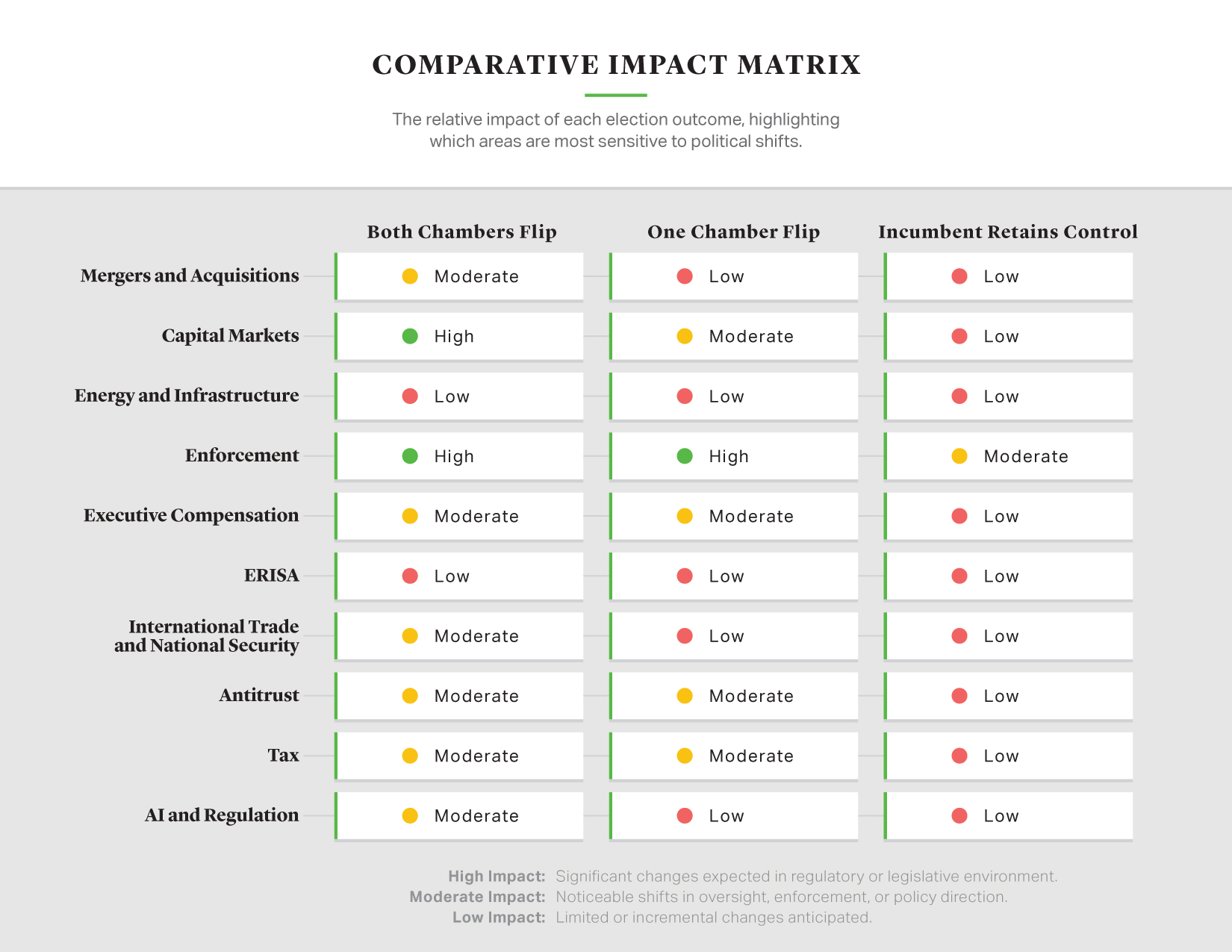
High Impact: Significant changes expected in regulatory or legislative environment.
Moderate Impact: Noticeable shifts in oversight, enforcement, or policy direction.
Low Impact: Limited or incremental changes anticipated.
Energy and Infrastructure
Energy and infrastructure issues currently enjoy bipartisan attention, with core concerns such as energy affordability, grid reliability, and infrastructure cost allocation expected to remain central regardless of congressional control.
- The election outcome is more likely to influence preferences around energy generation mix, permitting reform, and congressional oversight intensity rather than the underlying policy priorities.
- State-level decision-making will continue to play a significant role in project development, particularly for data center infrastructure.
- Additionally, evolving federal priorities may shape the pace and scope of infrastructure investment incentives, potentially affecting the financing and structuring of large-scale projects.
Enforcement
Enforcement priorities are largely driven by executive branch leadership and are not expected to shift dramatically with changes in congressional control.
- However, a full change in control of Congress could intensify oversight through appropriations riders, funding mandates, and transparency requirements, increasing compliance obligations for companies.
- Congressional investigations targeting private-sector actors are anticipated to rise substantially, especially focusing on perceived favoritism and potential corruption, affordability issues, including use of personal information for pricing, and enforcement resolutions in controversial areas.
- In a divided government, oversight may become an arena for conflict, with parallel investigations by both parties potentially complicating legal strategies.
- Retention of incumbent party control will maintain current enforcement priorities, with state-level enforcement filling gaps left by dormant federal agencies.
Executive Compensation
The executive compensation landscape is shaped by recently enacted tax legislation and ongoing SEC disclosure reform initiatives. The One Big Beautiful Bill Act (OBBBA) has permanently established the individual income tax rate framework and expanded the Section 162(m) deduction limitation, providing a stable baseline for compensation tax planning across all election scenarios. The SEC’s proposed overhaul of executive compensation disclosure rules, including significant simplifications for most public companies, is advancing but remains vulnerable to political dynamics.
- A full change in congressional control could slow or reshape these reforms through oversight and appropriations influence, and could bring hearings on OBBBA’s fiscal effects, including pressure to further tighten Section 162(m). A new majority could also advance non-compete restrictions, such as the pending Workforce Mobility Act, through committee.
- In a split Congress, the chamber that flips matters: a Senate flip would affect SEC confirmation dynamics for future commissioners, while a House flip would give the House Financial Services Committee oversight and subpoena authority over the SEC’s deregulatory posture.
- Retention of incumbent control is the scenario most likely to see SEC disclosure reforms finalized substantially as proposed, potentially exempting over 75% of public companies from CD&A, say-on-pay, pay ratio, and pay-versus-performance disclosure by the 2027-2028 proxy season. Companies should also evaluate now whether to settle 2026 compensation before Section 162(m)’s expanded covered-employee definition takes effect in 2027. ESG-linked compensation metrics continue to evolve as a market practice rather than a legislative mandate, with political developments influencing transparency and disclosure approaches.
ERISA
Regulations under ERISA are expected to remain largely unaffected by midterm election outcomes due to continued existing administration leadership at the Department of Labor. The DOL’s regulatory agenda includes finalizing rules on 401(k) investment options, ESG considerations, and revisions to prohibited transaction exemptions.
- These regulatory processes are generally insulated from congressional control, especially given the Congressional Review Act (CRA) mechanism is limited by presidential veto power.
- Legislative efforts to amend ERISA, such as the ERISA Litigation Reform Act, may continue independently of election results.
- Market participants should remain attentive to potential shifts in congressional priorities that could influence the timing and focus of future ERISA-related legislative proposals.
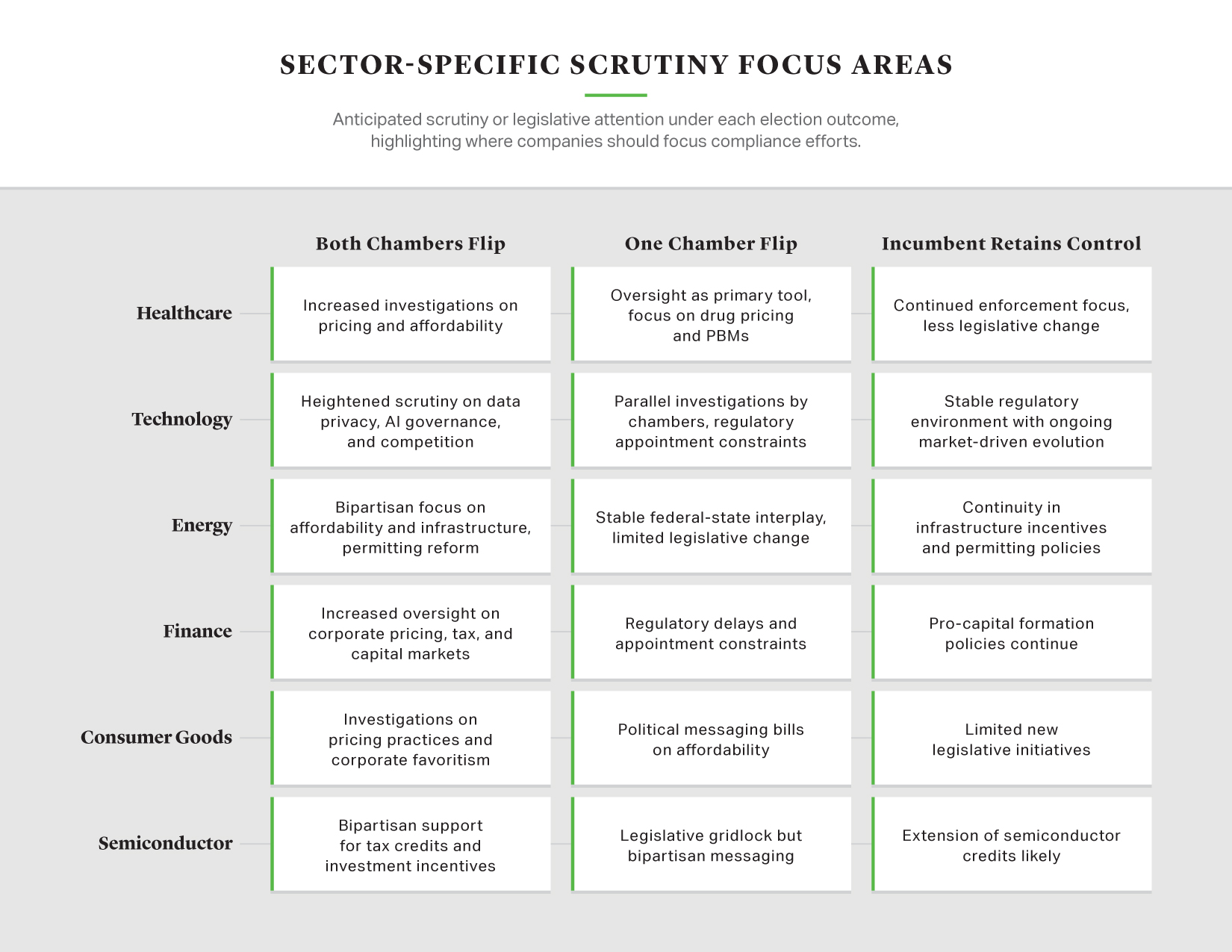
Sector-Specific Scrutiny Focus Areas
Anticipated scrutiny or legislative attention under each election outcome, highlighting where companies should focus compliance efforts.
International Trade and National Security
Trade and national security regulatory frameworks are primarily shaped by executive orders and agency rulemaking, with bipartisan congressional support for key legislation. A change in congressional control is unlikely to fundamentally alter the legal landscape but could increase legislative oversight and appropriations constraints on trade enforcement agencies.
- China-related legislation remains bipartisan, with oversight activities continuing regardless of party control.
- Tariff policy could see legislative proposals aimed at reforming presidential tariff authorities, though such measures face veto risks. Extension of Section 122 tariffs is uncertain under a change in congressional control due to congressional approval requirements.
- The renegotiation of the United States-Mexico-Canada Agreement (USMCA) will involve congressional engagement, with partisan composition influencing legislative conditions related to labor, environment, and trade protections.
Tax
Tax policy is shaped by the interplay of congressional control, presidential veto power, and bipartisan priorities, with implications in all three scenarios.
- In all three scenarios, bipartisan cooperation may be possible in narrow areas of agreement, such as extending semiconductor tax credits, tax-free tips and overtime, the $6,000 deduction for seniors, and cryptocurrency tax legislation. With respect to cryptocurrency, Congress could enact the Digital Asset Tax Certainty Act or similar legislation, which would extend to digital assets a number of rules that apply to stock and securities (e.g. anti-wash sales, constructive sales, the safe harbor for foreign persons trading in the United States for their own account, and mark-to-market taxation for dealers and traders), and simplify the taxation of stablecoins.
- A full change in congressional control is likely to result in legislative gridlock for most issues, with the new majority able to block minority-sponsored bills but unable to override vetoes. The new majority could seek to restore IRS funding cut in 2025.
- If control changes in only one chamber, legislative gridlock will persist, with tax proposals largely serving political messaging ahead of the 2028 elections.
- Retention of incumbent party control would maintain current tax policies, with limited new tax priorities.
AI and Regulation
AI regulation is shaped more by whether the administration and the industry can remain aligned rather than congressional control alone, since a comprehensive federal AI safety bill is seen as unlikely to pass under any scenario absent a major triggering incident. Legislative efforts at the state level will likely continue in all scenarios, though with more intensity in a partial flip or incumbent party control.
- A full change in congressional control could spark a new wave of regulatory efforts and increased scrutiny of AI developers, but more targeted, consensus-based measures, including protecting children, cybersecurity, and already-regulated sectors like health and financial services, are more plausible, while the executive branch would likely continue its preferred self-regulatory model through executive agency action or alignment with industry leaders rather than through legislation.
- Outcomes are not expected to differ meaningfully in a partial flip of congressional control, and depending on which chamber holds subpoena power, the emphasis may shift to hearings and investigations rather than passed legislation; pending AI-related litigation would likely continue unaffected, and state-level developments would remain an important parallel track.
- In the event the incumbent party maintains control, new and additional industry calls for action are expected to continue with little-to-no federal response, and any action taken will likely be limited to measures framed as not impeding AI development, such as cybersecurity and national security.
Risk and Opportunity Radar
A brief strategic overview of risks and opportunities for businesses under each election outcome.
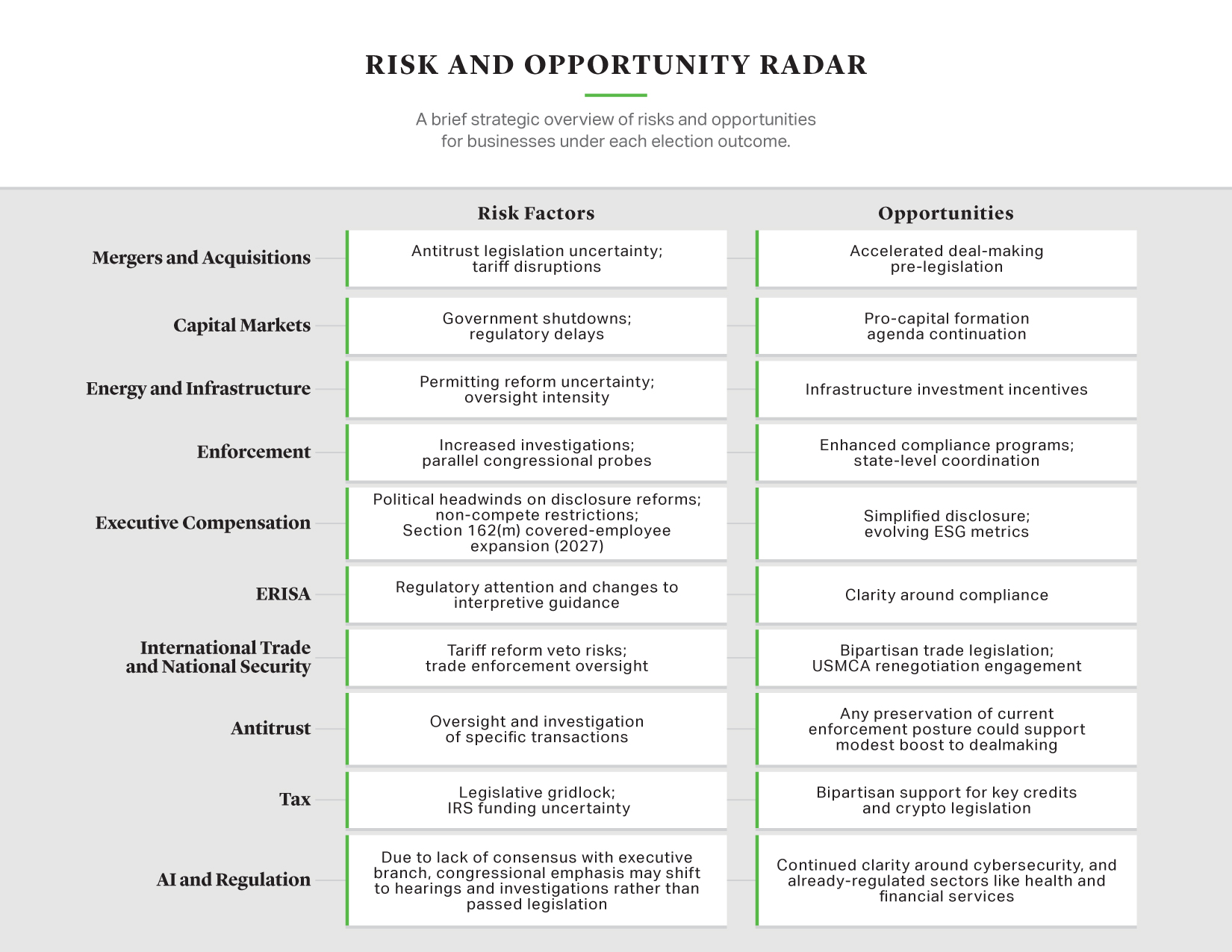
The 2026 Midterm elections will influence the U.S. legal and regulatory environment across multiple business and commercial law domains. While executive branch leadership and agency priorities remain critical drivers, congressional control affects legislative initiatives, oversight intensity, and regulatory appointments. The three possible mid-term election outcomes each present distinct implications for deal-making, capital markets, enforcement, compensation, trade policy, and tax. Organizations should monitor these developments closely and engage proactively with regulatory processes and legislative developments to navigate the evolving landscape effectively.