

We’re Not in Kansas Anymore: The SEC Proposes Sweeping Reform of Executive Compensation Disclosure
November 23, 2026
On November 13, 2026, the U.S. Securities and Exchange Commission (the SEC) proposed the most comprehensive reform of executive compensation disclosure since 2006 (the Proposal)[1], which, if adopted, would fundamentally change how executive pay is presented to investors pursuant to Item 402 of Regulation S-K.[2]
The Proposal would shift executive compensation disclosure toward a more flexible, principles-based framework, but require more company judgments about materiality and presentation. Disclosure would only be required for those individuals who served as principal executive or principal financial officer and the core compensation tables would be replaced with three tables separately reporting compensation earned, compensation granted, and the status of equity awards. The aggregate perquisite disclosure threshold would increase to $150,000, and companies would have greater flexibility in determining what constitutes a perquisite. CD&A, pay-versus-performance, pay ratio, and clawback disclosures would be simplified, while non-GAAP compensation measures would require additional reconciliation and explanation.
The Proposal does not affect the 2027 proxy season. If final rules are published in the Federal Register in 2027, calendar-year companies would generally first be required to comply in their 2029 proxy statements covering 2028 compensation. Full voluntary compliance could begin after January 1, 2028. Comments on the Proposal are due by January 19, 2027.
Below, we provide a high-level summary of the Proposal, before reviewing the key proposed amendments in greater detail and describing the related implications for reporting companies.
Summary of Key Changes
Category | Key Changes |
NEOs |
|
Compensation Tables |
|
Perquisites |
|
CD&A |
|
Pay Versus Performance |
|
Pay Ratio |
|
Clawbacks |
|
Termination / CIC Payments |
|
Director Compensation |
|
Eliminated Items |
|
Golden Parachutes |
|
Registration Statements |
|
SRCs, EGCs, and FPIs |
|
Effective Date |
|
Whose Pay Is Disclosed: Two Named Executive Officers
Named executive officers (NEOs) would be limited to individuals who served as the principal executive officer (PEO) or principal financial officer (PFO) during the last completed fiscal year.[3] In most cases, this would reduce the number of NEOs from five or more to two.[4]
Under the current rule applicable to companies other than smaller reporting companies (SRCs) and emerging growth companies (EGCs), companies must identify their three most highly compensated executive officers other than the PEO and PFO each year. Commenters on the SEC’s roundtable indicated that the number of individuals covered under the current rule contributes to the significant complexity and burdens of the disclosure without a commensurate benefit to investors.
The reduction of individuals subject to disclosure is likely to have the most significant impact on companies with a key, highly paid non-PEO/non-PFO executive—e.g., an executive chairman—who would no longer be included as an NEO based on compensation received, despite their relative importance to the company and to investors, although director compensation and other applicable disclosure requirements (including with respect to dual or co-PEOs) may continue to apply. This proposed change would also provide significant relief to companies with large executive officer teams, particularly in years with executive turnover.
Companies should consider the implications of this proposed shift across a number of disclosure areas. For example, individual beneficial ownership disclosure based solely on NEO status would generally be limited to the PEO and PFO, while separate disclosure for directors and for directors and executive officers as a group would remain. One of the most notable implications would be in Form 8-K reporting. Item 5.02(e) Form 8-K reporting would generally be limited to material compensatory arrangements involving the PEO or PFO, with the existing materiality triggers retained. However, Item 5.02(c) of Form 8-K would continue to require a description of any material plan or arrangement entered into in connection with the appointment of a new president, principal accounting officer, principal operating officer, or person performing a similar function (in addition to a PEO or PFO), so compensation arrangements entered into in connection with key appointments would still require disclosure at the outset. Departure reporting under Item 5.02(b) of Form 8-K would also continue for the other expressly covered officer roles (i.e., principal executive officer, president, principal financial officer, principal accounting officer, principal operating officer, or any person performing similar functions), regardless of NEO status.
Similarly, Item 601 of Regulation S-K currently requires companies to file all NEO compensatory agreements as exhibits to regular filings under the Securities Exchange Act of 1934 (the Exchange Act), regardless of materiality, and the proposed change to the scope of NEOs would apply that requirement only to the PEO and PFO (in addition to directors); arrangements involving other executive officers would continue to be required to be filed unless immaterial in amount or significance.
Ancillary Impacts
Fewer NEOs would not necessarily mean less compensation tracking. The Proposal notes informal U.S. Department of the Treasury (the Treasury) staff advice that the deduction limitation under Section 162(m) of the Internal Revenue Code (Section 162(m)) would continue to cover the three other most highly compensated executive officers.[5] The separate expansion of Section 162(m), effective for taxable years beginning after December 31, 2026, would also require companies to identify five additional highly compensated employees, whether or not executive officers. Under the Treasury’s proposed implementing regulations, those employees would be ranked using otherwise tax-deductible compensation, rather than the current SEC compensation measure used to identify the three highest-paid executive officers.[6] Further guidance and clarification will likely be required from the Internal Revenue Service (IRS) as to the impact of the SEC’s proposed rules on identification of the next three highest-paid executive officers for purposes of Section 162(m), although one could imagine the IRS adopting this same “otherwise tax-deductible compensation” metric for identification of such executive officers. Companies should also reassess Item 404 related-person transaction exemptions where compensation would no longer be reported under Item 402.[7]
A New Tabular Framework
Three new tables, each with an accompanying narrative, would replace the four primary tables under the current rule, including the Summary Compensation Table, Grants of Plan-Based Awards Table, Outstanding Equity Awards at Fiscal Year-End Table, and the Option Exercises and Stock Vested Table.[8] In addition, the Pension Benefits and Nonqualified Deferred Compensation Tables would be eliminated.[9]
The proposed tables would answer three different questions:
- What compensation opportunity did the company provide?
- What compensation did the executive earn?
- What is the status of each equity award between being granted and earned?
The new Granted Compensation Table would report salary, non-equity awards (including cash bonuses), and equity awards granted in each covered year, generally at target value. The new Earned Compensation Table would report all material compensation earned in each covered year, including retirement contributions and perquisites, with stock awards treated as earned on vesting and options earned on exercise. Companies other than SRCs, EGCs, and newly reporting issuers would generally present three fiscal years in each table, though the SEC is requesting comment on whether all companies should be required to present only two fiscal years, consistent with the treatment for SRCs and EGCs.
The new Status of Equity Awards Table is intended to follow an award’s lifecycle from the Granted Compensation Table to the Earned Compensation Table by tracking each equity award on an award-by-award basis from grant until it is earned or expires.
Granted Compensation Table
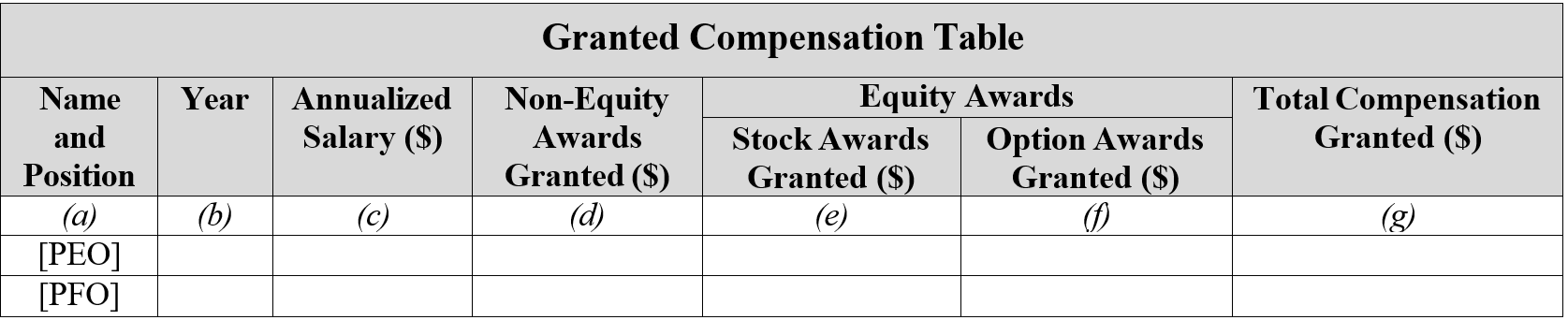
Intended to resemble the “total direct compensation” metrics many companies already present, this table would capture the compensation opportunity granted for each covered year and would combine concepts from the Summary Compensation Table and the Grants of Plan-Based Awards Table.[10] Unlike the Earned Compensation Table, it would be limited to salary, non-equity awards, and equity awards and would not purport to present a comprehensive picture of compensation. Salary would be reported at its fiscal year-end annualized value, reflecting any raises effective during the year, rather than salary actually earned during the year.[11] Non-equity awards, including discretionary, signing, and retention bonuses, would be reported in a single column at aggregate target value.[12] The table would not require disclosure of threshold or maximum amounts (as the Grants of Plan-Based Awards Table currently does), although supplemental disclosure may be needed where material to an investor’s understanding of the information presented in the table.[13]
Equity awards would be reported based on their grant date fair value under Financial Accounting Standards Board Accounting Standards Codification Topic 718 (FASB ASC Topic 718), assuming achievement of target outcome(s), rather than the probable outcome of performance conditions currently used in the Summary Compensation Table (which also requires footnote disclosure of the maximum value of the award if not reflected in the table).[14] For equity awards with multiple performance outcomes, target outcome means achievement at the 100% level and, for performance awards with binary performance outcomes, target outcome means that the award criteria are met and the award is fully earned. This could cause reported values to diverge from financial statement values, particularly for awards with market conditions or where target achievement is not probable. Where target and probable outcomes diverge materially (e.g., “moonshot” awards), the principles-based framework would require supplemental disclosure.[15]
Grant-year reporting would remain the default, but a company could elect to report an equity award in the fiscal year immediately prior to grant if it considers the award to be for prior-year performance and the award is granted in the first fiscal quarter of the following year, provided the approach is applied consistently across the years presented and disclosed.[16] The SEC indicated this is intended to address the timing mismatch under the current rule, where an annual bonus for a particular year’s performance is reported in that year but an equity award granted for the same performance period in the following year’s first quarter is reported in the following year.[17] Conversely, a non-equity award earned in a year before it is granted (e.g., a discretionary bonus granted in the first quarter for prior-year performance) would be reported in the Granted Compensation Table for that earlier year in respect of which it was earned, so that an award is never reported as earned before it is reported as granted.[18] Companies considering the equity election should consider documenting how an award relates to prior-year performance.[19]
Earned Compensation Table
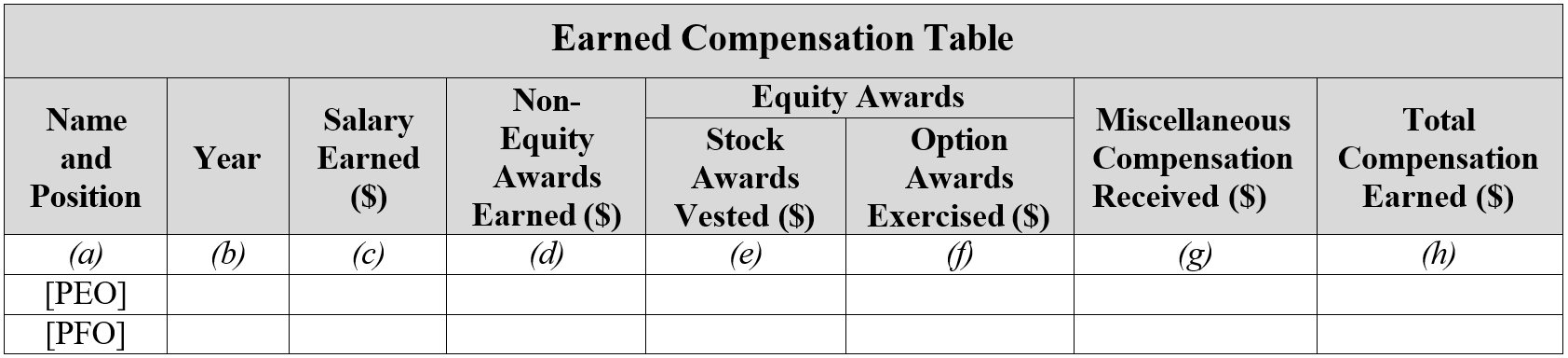
This table would combine concepts from the Summary Compensation Table and the Option Exercises and Stock Vested Table to show compensation outcomes.[20] Its columns would cover salary earned (largely tracking the current salary column), non-equity awards earned (consolidating today’s separate “Bonus” and “Non-equity incentive plan compensation” columns, as several commenters had requested),[21] stock awards vested (valued at the number of shares or units vested multiplied by the closing market price on the vesting date), option awards exercised (valued at the number of underlying securities multiplied by the difference between the closing market price on the exercise date and the exercise price), and miscellaneous compensation received.[22] As a result, the table would reflect value realized on equity awards during the year regardless of when they were granted, rather than the grant date fair value of current-year grants.[23]
Consistent with the principles-based approach of the proposed rules, several footnote requirements under the current rule would not be carried forward, including separate quantification of all earnings on non-equity incentive plan awards, disclosure of non-cash compensation received in lieu of salary or bonus, and quantification of deferred amounts realized on vesting or exercise.[24] The Miscellaneous Compensation Received column would largely track today’s “All other compensation” column, but with a $150,000 perquisite threshold (up from $10,000, as discussed in more detail below), and would also absorb retirement-related amounts currently reported elsewhere.[25] In particular, the current Summary Compensation Table column reporting the change in the actuarial present value of accumulated pension benefits would be replaced with service cost and prior service cost under defined benefit and supplemental executive retirement plans, largely tracking the current pay-versus-performance rule.[26] In addition, above-market or preferential earnings on nonqualified deferred compensation would move into this column, along with company contributions to defined contribution and nonqualified deferred compensation plans.[27] The Miscellaneous Compensation Received column would also include company-paid exercise prices or taxes on option exercises, dividends on outstanding awards (without today’s carve-out for amounts factored into grant date fair value), and any other compensation the company determines is material or elects to disclose.[28]
Together, the Granted Compensation Table and the Earned Compensation Table would show compensation opportunities and their eventual outcomes.
Status of Equity Awards Table
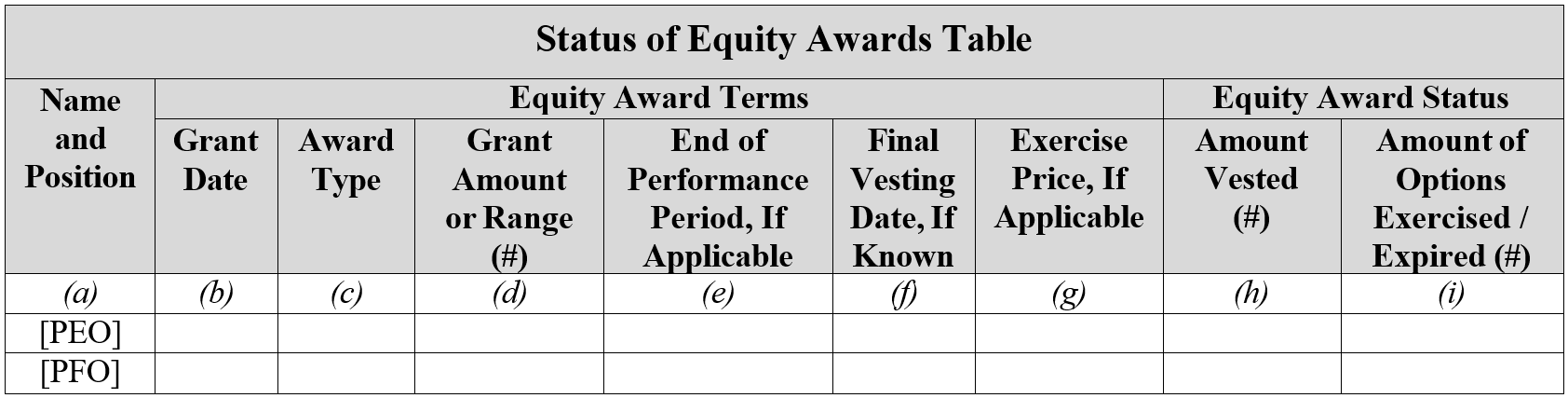
Effectively a revised Outstanding Equity Awards at Fiscal Year-End Table incorporating elements of the Grants of Plan-Based Awards Table, this table is meant to “bridge the gap” between the other two by following each equity award, row by row, from when it first appears in the Granted Compensation Table through the year it is reported as fully vested (stock) or fully exercised or expired (options).[29] The SEC cited roundtable feedback that it is currently “incredibly hard to follow one equity award through its life[cycle].”[30]
For each award, the table would show the grant date, award type, grant amount or range (e.g., “Threshold: 25,000; Target: 100,000; Maximum: 200,000”), end of performance period, final vesting date, exercise price, amount vested, and options exercised/expired (e.g., “Exercised: 50,000; Expired: 10,000”).[31] Each award would be reported in its own row, and option awards with different exercise prices or expiration dates would be reported as separate awards. Because table amounts would be shown in number of shares (rather than dollars) and would illustrate the potential range of performance outcomes, companies would no longer have to recalculate hypothetical values based on year-end stock price and assumed performance outcomes.[32] Information would generally be presented as of fiscal year-end; however, if the company reports an equity award granted during the first quarter of the year in the prior year’s Granted Compensation Table, then the company would have to report the terms and status of all equity awards as of the end of the first quarter (or, if earlier, the latest practicable date).[33]
Companies would also need to disclose the date as of which the information in the table is reported (typically fiscal year-end), the vesting schedule and the material terms of the performance, market, and/or service conditions for each award, which they could do in the table, footnotes to the table, accompanying narrative, or the Compensation Discussion and Analysis (CD&A). A standard vesting schedule could satisfy the vesting requirement, with disclosure of any material deviations.[34]
Presentation Requirements
Companies would have flexibility in presenting the new tables, including omitting empty tables or columns and splitting a column into multiple columns or presenting a supplemental table.[35]
Large accelerated filers (LAFs) would be required to tag the information disclosed in the new tables in Inline eXtensible Business Reporting Language (Inline XBRL) in an effort to allow investors to better analyze the data.[36] Footnotes would be excluded, and tagging would be optional for other filers. At the same time, the existing Inline XBRL tagging requirements for pay-versus-performance information and clawback recovery disclosure would be removed.
These new tables would be the most significant implementation change for most companies. If the proposed rules are adopted, companies would need to conduct a mapping exercise to determine where this data sits in their equity administration, payroll, and retirement systems, consider what internal controls would be needed over target values and earned amounts, and coordinate early with compensation consultants. The Proposal does not propose a phase-in, so a company’s first filing under the new rules may need to present three years of information in the Granted Compensation Table and the Earned Compensation Table.[37]
To illustrate how the proposed rules would change compensation disclosure, please see the attached Appendix, which builds on the Proposal’s Dorothy Gale hypothetical.[38] Using the same facts, it shows how the information in the SEC’s three proposed tables would be presented in the current Summary Compensation Table, Grants of Plan-Based Awards Table, and Option Exercises and Stock Vested Table under the current rules.
Perquisite Guidance and Disclosure
The Proposal would give companies more flexibility to classify and value perquisites and would raise the aggregate disclosure threshold from $10,000 to $150,000 per NEO.
Guidance
Under the SEC’s existing interpretive guidance (the 2006 Guidance), an item is not a perquisite if it is “integrally and directly related” to the performance of the executive’s duties, a concept the SEC described as “narrow.” Otherwise, an item is a perquisite if it confers a direct or indirect benefit with a personal aspect, regardless of any business reason or convenience to the company, unless it is generally available to all employees on a nondiscriminatory basis.[39] The 2006 Guidance also includes a non-exhaustive list of examples that would require disclosure as perquisites or personal benefits, including personal security. Many roundtable participants expressed that the 2006 Guidance should be updated to better reflect the current work environment and typical company practice.
Under the Proposal, companies would have the flexibility to determine, based on their specific facts and circumstances, whether an item is integrally and directly related to the performance of the executive’s duties, as long as such determination is reasonable and made in good faith. As an example, a company could reasonably, and in good faith, conclude that around-the-clock personal security for its PEO or PFO, or required use of company aircraft for personal travel due to security concerns, is integrally and directly related to the executive’s duties and therefore not a perquisite.[40] If the company reaches that conclusion at the first step, it does not matter if the item confers a personal benefit or whether it is generally available to all employees on a nondiscriminatory basis.
Although removing the examples would not automatically exempt those items from perquisite treatment, the Proposal gives companies meaningful flexibility and discretion to determine whether a particular item is “integrally and directly related” to the performance of the executive’s duties.[41] If the rules are adopted as proposed, compensation committees may wish to revisit security and other perquisite programs, and companies should plan to document the basis for their good-faith determinations, for example through security assessments and committee materials.[42] Companies should keep in mind, however, that the current threshold and 2006 Guidance continue to apply until any final rule takes effect, including for the 2027 proxy season.
Disclosure
Current rules require disclosure of perquisites in the Summary Compensation Table for each NEO when the total amount of perquisites is $10,000 or more. The proposed rule would increase the aggregate reporting threshold to $150,000 (which would apply to amounts required to be disclosed in the Earned Compensation Table) and add a new tracking exclusion that would exclude any individual perquisite that is a de minimis fringe benefit under Section 132(a)(4) of the Internal Revenue Code from the calculation as to whether the aggregate reporting threshold is met.[43] The $10,000 threshold has not been updated since 2006, and there is no tracking exclusion under the current rule, such that companies must monitor and track every potential perquisite, however small, to determine whether the threshold is met. The proposed increase is intended to modernize the required reporting threshold to reflect both the passage of time since the $10,000 threshold was introduced and developments in executive compensation, recognizing that benefits modestly above $10,000 may be immaterial in light of current compensation levels. Gross-ups on perquisites (including perquisites not otherwise required to be disclosed because of the thresholds described above) would be required to be disclosed in the Miscellaneous Compensation Received column of the Earned Compensation Table.[44]
The Proposal would also provide companies with flexibility to determine how best to value perquisites by eliminating the requirement that perquisites be valued on the basis of the aggregate incremental cost to the company, and would permit the use of amounts attributable to perquisites for federal income tax purposes. If the proposed rules are adopted, companies would need to consider whether to establish a supportable, consistently applied valuation methodology, since valuation affects whether the reporting threshold is crossed, and consider whether the methodology itself is material to understanding the disclosure (such that the methodology itself would need to be disclosed).
Under the current rule, once the threshold is met, each perquisite must be identified by type and any perquisite exceeding the greater of $25,000 or 10% of total perquisites must be quantified in a footnote. The Proposal would not carry forward these identification and quantification requirements, meaning that individual perquisites would generally only need to be identified or quantified to the extent material.[45]
CD&A: Fewer Required Topics, Greater Emphasis on Strategy
Under the Proposal, the CD&A, which currently must address seven topics, would only be required to address three topics: (1) the objectives of the compensation program in relation to corporate strategy; (2) the material elements of compensation and how amounts are determined; and (3) if applicable, whether and how the company considered the results of its most recent say-on-pay vote. The current list of 15 example topics would also be eliminated.[46] Many roundtable commenters expressed concerns with the length of current CD&As. The SEC noted that the existing illustrative list may have created a perception that each topic and example must always be addressed, contributing to the length and creating repetitive and/or immaterial disclosure. The proposed rules would move to a less prescriptive CD&A, though the current example topics could still warrant discussion if material. Though the second and third topics in the proposed rule mirror existing topics under current rules, the corporate-strategy linkage is new and calls for more than generic statements about recruiting, retaining, and motivating executives: companies would need to explain why their executive compensation programs and designs (including performance measures and measurement periods) advance their particular strategic priorities.
SRCs and EGCs would remain exempt from the CD&A requirement, and the 2026 Filer Status Proposal,[47] if adopted, would extend that accommodation to the proposed new category of “non-accelerated filers” (NAFs).[48]
The Proposal would allow a shorter, more tailored discussion with an emphasis on materiality. In practice, proxy advisor and institutional investor expectations, particularly following a low say-on-pay vote, may continue to drive longer and more complex disclosure, as may conservative approaches to materiality judgments. If the proposed rules are adopted, compensation committees and proxy drafting teams would need to consider which elements of the existing discussion remain material and how the CD&A may need to be adjusted to work in tandem with the new compensation tables.
Non-GAAP Measures: A New Disclosure Burden
The Proposal would require quantitative reconciliation to the most directly comparable GAAP measure for non-GAAP target levels or company-selected financial performance measures based on historical results. This requirement would apply throughout Item 402, not just in the CD&A. Disclosure of non-GAAP target levels that are based on projections, in contrast, would have to include a narrative description of how the non-GAAP financial measure is calculated from the company’s audited financial statements. Companies would also need to explain why the non-GAAP financial measure is more appropriate than a GAAP financial measure for determining compensation or, for company-selected measures, for explaining the pay-versus-performance relationship. Today, only a description of how the measure is calculated from the audited financial statements is required.[49] Non-GAAP target levels and company-selected financial performance measures would remain exempt from Regulation G and Item 10(e) of Regulation S-K.[50] Qualifying confidential performance targets could still be omitted where disclosure would cause competitive harm.
Pay Versus Performance
The current pay-versus-performance disclosure requirements of Item 402(v) were adopted in 2022 to comply with Section 953(a) of the Dodd-Frank Wall Street Reform and Consumer Protection Act of 2010 (the Dodd-Frank Act), and the associated calculations have become one of the most technical parts of the proxy statement compensation disclosure. The SEC is aiming to significantly simplify the required disclosure by replacing the specialized “compensation actually paid” metric with the total from the Earned Compensation Table, limiting required performance measure disclosure to cumulative total shareholder return (TSR), and reducing the number of fiscal years covered from five to three to match the other compensation tables.[51] In tandem with the changes to the NEO definition, pay-versus-performance disclosure would only be required for the PEO and PFO, each on an individual basis.
Under the current rule, compensation actually paid is derived from the Summary Compensation Table total by adding and subtracting various pension and equity award values determined through a series of complex calculations. Many companies engage outside compensation consultants and accounting firms to perform these calculations, which are used only for pay-versus-performance disclosure. Replacing compensation actually paid with the total from the Earned Compensation Table would largely eliminate the need for that specialized work and would more closely tie pay-versus-performance disclosure to the rest of the CD&A and tables.
The proposed rules would also eliminate the requirement to disclose net income, peer group TSR, a “Company-Selected Measure,” and a tabular list of financial performance measures used to link executive compensation and company performance. Instead, the company would provide a clear description of the relationship across the last three fiscal years between each of the PEO’s and PFO’s total compensation earned and the company’s cumulative TSR.
Companies could voluntarily disclose additional financial performance measures, but should present them consistently across the three years or explain any changes. If the proposed rules are adopted, companies would need to monitor how proxy advisors adapt their pay-for-performance methodologies and whether investors continue to request information no longer prescribed by the SEC.
Pay Ratio
Current Item 402(u), adopted in response to Section 953(b) of the Dodd-Frank Act, requires companies to disclose the ratio between total compensation received by the PEO and that of the median employee, determined in accordance with a set of complicated identification rules regarding part-time, seasonal, and non-U.S. employees. Under the proposed rules, the population used to identify the median employee would be limited to full-time employees in the U.S. and its territories, excluding part-time, seasonal, and temporary employees, though a non-U.S. PEO would continue to be included. The median employee would be redetermined at least once every five years rather than every three.[52]
Annual total compensation for the PEO and the median employee would be measured using the amounts in, or methodology of, the Granted Compensation Table.[53] Because the Granted Compensation Table is limited to salary, non-equity awards, and equity awards, items such as pension benefits and company retirement plan contributions would no longer be included in either the PEO’s or the median employee’s total compensation.[54] The detailed instructions on methodology, estimates, cost-of-living adjustments, and annualizing would be replaced with a general statement that companies may use reasonable methods, adjustments (including annualizing compensation of full-time employees employed for less than the full year), and estimates. Requirements to describe the methodology, the compensation measure used, and material assumptions would also be eliminated.[55] As a trade-off to the simplified calculation methodology, the current pay-ratio transition periods for newly reporting companies and those losing SRC or EGC status would be removed.
The Proposal would most benefit multinational companies with large non-U.S. workforces. Companies approaching a scheduled redetermination may wish to consider timing once the rule is final.
Clawbacks
The clawback requirements were introduced in 2022 to comply with Section 954 of the Dodd-Frank Act and include both policy and disclosure requirements. The proposed rules would eliminate the requirement under current Item 402(w)(2) to briefly explain why a restatement did not require compensation recovery. Companies would still be required to disclose, under redesignated Item 402(g), the date the company was required to prepare the restatement, the aggregate amount of erroneously awarded compensation and how it was calculated, amounts outstanding at fiscal year-end (including individual amounts owed by each current or former NEO that, as of year-end, have been outstanding for at least 180 days since the company determined the amount owed), and any recovery amounts forgone as impracticable. However, recovery amounts forgone as impracticable would no longer need to be broken out for each current and former NEO and for other executive officers as a group.
The proposed rules would also remove the mandatory clawback check boxes on the cover pages of Forms 10-K, 20-F, and 40-F, which have caused confusion since their introduction. The first check box flags whether the financial statements reflect the correction of an error, whether or not required, and the second flags whether any such correction was a restatement requiring a recovery analysis.
The relief set forth in the proposed rules is limited to disclosure. Companies are still required to maintain their existing clawback policies adopted under Exchange Act Rule 10D-1, and must continue to assess whether any restatement, including a “little r” restatement, triggers a recovery analysis. Recovery obligations and aggregate recovery disclosures would continue to cover the broader population of executive officers subject to the policy, not just the PEO and PFO.
Potential Payments Upon Termination or Change in Control
Under the proposed rules, the current requirement to describe and quantify potential payments and benefits to each NEO under various hypothetical termination and change-in-control scenarios, assuming the triggering event occurred on the last business day of the fiscal year, would be eliminated. Instead, redesignated Item 402(i) would require only a description of the material terms of each written or unwritten arrangement providing for payments at, following, or in connection with any termination or a change in control, for each person who served as PEO or PFO during the last completed fiscal year.[56] This would largely extend to all companies the narrative approach currently available to SRCs and EGCs under Item 402(q)(2). Nondiscriminatory arrangements available generally to all salaried employees could continue to be omitted, and a new instruction would permit omission altogether if the required disclosure has already been provided in a Form 8-K filed under Item 5.02.[57]
Item 402(i) would no longer require hypothetical year-end severance and change-in-control calculations, often presented in multiple tables and based on various assumptions regarding performance and equity award values, for the annual proxy. Companies should still expect to describe the material terms of their severance, retention, and change-in-control arrangements for the PEO and PFO, either in the proxy statement or in the applicable Item 5.02 Form 8-K. Consistent with the narrower NEO definition, arrangements with other executives would no longer be covered. Actual termination or change-in-control amounts paid or accrued to an NEO would still be reportable in the Earned Compensation Table’s Miscellaneous Compensation Received column.
Golden Parachute Compensation in Merger Proxies

Under the proposed rules, golden parachute disclosure required under current Item 402(t) in merger proxies, Forms S-4 and F-4, going-private and tender offer documents, and other solicitations subject to Item 14 of Schedule 14A, would be simplified to streamline the tabular disclosure and provide more flexibility for narrative disclosure about golden parachute compensation.
The required tabular disclosure would be reduced from seven dollar columns to four, with the current pension and nonqualified deferred compensation, perquisites and personal benefits, tax reimbursement, and other columns being combined into a single miscellaneous column covering any other material transaction-related compensation.
Companies would be required to continue to disclose material information that is necessary to an understanding of the payments quantified in the proposed tabular disclosure, but the prescriptive requirements regarding mandatory footnotes for each column, the requirement to provide additional golden parachute compensation tables to cover new or revised arrangements and understandings, and the non-exhaustive list of examples of material factors necessary to an understanding of the golden parachute compensation would be eliminated in favor of a more principles-based approach. Separate disclosure distinguishing previously approved arrangements from new or revised arrangements subject to a separate advisory vote would nevertheless remain.
Consistent with the proposed change to the NEO definition, the golden parachute tables would only cover the PEO and PFO of the target and acquiring companies.
Deal teams should still expect to prepare quantified golden parachute calculations for the PEO and PFO of each party. The materiality catch-all would govern the Miscellaneous column, but cash severance and specified equity amounts would remain separately quantified. The revised column structure and narrative would provide presentation flexibility. Because the annual proxy would no longer contain quantified severance estimates, the golden parachute table may become the primary source of quantified change-in-control payments, which could draw more investor and proxy advisor scrutiny at the time of the transaction.
Director Compensation
Today, the Director Compensation Table largely mirrors the Summary Compensation Table with categories for cash fees, stock and option awards at grant date fair value, non-equity incentive plan compensation, change in pension value and nonqualified deferred compensation earnings, all other compensation, and a total, accompanied by a narrative of material factors. Under the proposed rules, companies would still describe the material aspects of their director compensation programs and the amounts earned by each director, but the tabular disclosure requirement would be eliminated.
Under proposed Item 402(k), companies would be required to describe the material aspects of their director compensation program, including separate quantification of cash and equity retainers for board, committee, chair and other roles. For each person who served as a director during any part of the year, companies would separately disclose cash fees earned, the value realized on stock vesting, option exercise, or transfers of awards for value (consistent with the Earned Compensation Table), any other material compensation, and any material information necessary to understand those amounts. Companies would also disclose the number of stock and option awards outstanding at year-end and, for each outstanding award, the grant date, vesting schedule, and material terms of any performance, market, or service conditions. The enumerated “other” categories would be replaced by a materiality catch-all, and pension and nonqualified deferred compensation items would no longer be specifically required to be disclosed.[58] The required information could be presented in any format, whether tabular, narrative, or both. Compensation an NEO receives solely for board service would be reported in the director disclosure and excluded from the executive compensation tables.[59]
One more substantive impact of these changes is that the proposed rules could make director pay appear to change even when the underlying compensation program has not. Reporting equity at vesting or exercise rather than at grant date fair value could produce materially different reported amounts for identical annual retainers, driven by stock-price movements and individual exercise decisions.
Other Disclosure Requirements That Would Be Eliminated
The Proposal would also eliminate Item 402(s) (narrative disclosure of compensation policies and practices as they relate to risk management) and Item 402(x) (policies and practices on the timing of option grants close in time to the release of material nonpublic information, and the related table).[60]
Item 402(s) currently requires companies to discuss their compensation policies and practices for all employees, including non-executive officers, as they relate to risk management and risk-taking incentives, to the extent risks arising from those policies are reasonably likely to have a material adverse effect on the company. The SEC observed in the Proposal that this disclosure is often formulaic, typically stating that the compensation committee conducted a risk assessment and concluded that no such risks exist, and that it expects that Management’s Discussion and Analysis under Item 303 and risk factors under Item 105 would continue to capture any material compensation-related risks.[61]
Item 402(x), adopted in 2022, requires narrative disclosure of how the board determines when to grant options, whether material nonpublic information is taken into account, and whether the company has timed disclosures to affect the value of executive compensation. It also requires tabular disclosure showing specified option and similar option-like awards granted to an NEO from four business days before to one business day after the filing or furnishing of a Form 10-Q, Form 10-K, or Form 8-K disclosing material nonpublic information. The table shows the grant date, number of underlying securities, exercise price, grant date fair value, and the percentage change in the stock price around the disclosure, and is tagged in Inline XBRL. The SEC noted in the Proposal that the narrative is largely boilerplate and that the table duplicates information available elsewhere or from public market data. It also noted that, where a company presents options as granted at-the-money but has engaged in “spring-loading” or “bullet-dodging,” the general requirement to disclose material information necessary to an understanding of the tables would still require disclosure.[62]
These changes would reduce disclosure requirements, but would not alter the underlying obligations. Compensation committees should continue to consider compensation risk and manage the timing of option grants with insider trading and other considerations in mind.
Registration Statements: More Time for Long-Form Filers
Under current rules, companies filing “long-form” registration statements, such as Forms S-1, S-4, S-11, 10, and N-2, generally must include Item 402 disclosure for each of the company’s last three completed fiscal years, subject to scaled and newly reporting company accommodations. This applies even when a company files on the first day of its fiscal year, limiting those companies’ ability to offer securities in the public capital markets until they can produce Item 402 disclosure for the immediately preceding fiscal year.
Under the Proposal, companies filing long-form registration statements would not need to include Item 402 disclosure for the most recently completed fiscal year until the earlier of the date that Item 402 information is disclosed in an Exchange Act filing or 120 days after fiscal year-end.[63] This would give long-form filers the same period already available to companies using short-form registration statements, such as Form S-3.[64] However, the Proposal would further require that if the registration statement would become effective after that deadline, the company would need to file a pre-effective amendment that includes the Item 402 disclosure.[65] In light of the extended deadline to provide updated Item 402 disclosure, the proposed rules would eliminate the delayed salary-and-bonus reporting accommodation and the related Item 5.02(f) Form 8-K follow-up mechanism.[66]
By allowing companies to delay Item 402 disclosure, the Proposal would ease pressure on early-year IPO and business combination timetables, though deal teams should still build their offering schedules to minimize any delay in providing updated information to investors.
Smaller Reporting Companies, Emerging Growth Companies, and Foreign Private Issuers
Smaller Reporting Companies and Emerging Growth Companies
Under current Item 402(l), SRCs and EGCs are generally subject to scaled disclosure requirements set out in separate parallel provisions of Item 402.[67] The proposed rules would streamline Item 402 by identifying the scaled disclosure rules that apply to SRCs and EGCs and consolidating them into a single paragraph for each group. However, in light of the 2026 Filer Status Proposal, which would significantly increase the number of companies eligible for scaled disclosure requirements, the SEC is not proposing any new accommodations for SRCs or EGCs in the Proposal. Both groups would generally provide two years in the Earned and Granted Compensation Tables and remain exempt from CD&A and pay ratio. EGCs (but not SRCs that are not EGCs) would remain exempt from pay-versus-performance and golden parachute disclosure. All three new tables would apply, potentially adding pension service-cost and equity-realization information not previously required under the scaled rules.
Separate Filer Status Proposal
The 2026 Filer Status Proposal could have a more fundamental effect. If adopted as proposed, companies qualifying as NAFs would be exempt from CD&A, pay ratio, pay-versus-performance, and golden parachute disclosure, as well as say-on-pay, say-on-frequency, and say-on-golden-parachute votes. Companies should therefore assess the two proposals together, rather than assume that every simplified requirement would apply to them.[68]
Foreign Private Issuers
The treatment of foreign private issuers (FPIs) would be largely unchanged. Consistent with the current rule, an FPI would be deemed to comply with Item 402 if it provides the information required by Items 6.B, 6.E.2, and 6.F of Form 20-F, along with additional requirements, as applicable.[69]
Timing and Transition
If adopted, the amendments would become effective on the January 1 after the adopting release is published in the Federal Register. Companies would be required to comply for their first full fiscal year ending on or after the effective date. Registration statements and prospectuses would need to comply if, on their initial filing date, they must contain financial statements for a fiscal year ending on or after the effective date of the final rule.[70] Companies could comply voluntarily at any time after the effective date, but only by complying with amended Item 402 in its entirety. No historical phase-in for the new tables is proposed, although the Proposal requests comment on whether one is needed.[71]
As an example, if the final rule were published in 2027, the amendments would take effect on January 1, 2028. A calendar-year company would first be required to comply for fiscal year 2028, generally in its 2029 proxy statement, and could elect to comply voluntarily in the 2028 proxy season. The current rules and guidance continue to apply in the meantime.
Key Takeaways
- No Change to 2027 Disclosures.Companies should continue preparing 2027 proxy statement disclosures under the current rules and guidance (including in respect of perquisites). The Proposal may change before adoption and companies should avoid premature implementation while identifying the reporting choices and data needs described in this memo.
- Assess Disclosure Controls and Procedures. Companies should begin to consider how disclosure controls and procedures would need to evolve to support the proposed rules’ new tables and greater reliance on materiality judgments, including how those determinations would be made, reviewed, and documented. New controls and procedures may also be required to coordinate non-GAAP compensation disclosures.
- Consider Ancillary Impacts. Less publicly available compensation data may temper benchmarking-driven pay increases, while narrower officer coverage and more aggregated disclosure would also make market comparisons and M&A diligence more difficult. Companies should consider how these changes could affect both their compensation-setting practices and the information available to evaluate executive arrangements in the transactional context or otherwise.
- Focus on Engagement. If the proposed rules are adopted, companies should proactively engage with shareholders and closely monitor any corresponding changes to proxy advisory firms’ voting guidelines. Understanding and addressing evolving investor and proxy advisor expectations will be critical to securing shareholder support for executive compensation proposals and minimizing the risk of adverse votes against compensation committee members.
- No Changes to Clawbacks and Risk Oversight.Clawback recovery policies and compensation risk oversight should not change, even though related disclosure may be reduced.
- Review Current Arrangements and Practices.Though it may be premature to undertake significant efforts, companies should consider reviewing plans, agreements, and governance policies that use NEO status to determine coverage or approval requirements, particularly where the definition automatically follows SEC rules, to identify any unintended effect of the proposed narrower definition.
- Monitor 2026 Filer Status Proposal.SRCs, EGCs, and other smaller companies should also follow the SEC’s separate 2026 Filer Status Proposal, which would significantly expand the number of companies eligible for scaled disclosure, to determine the full suite of scaled disclosure requirements applicable to them.
- Take Advantage of Public Comment Period. Companies should consider submitting comments on issues that may materially impact their business before the deadline of January 19, 2027.
If you have any questions concerning this memorandum, please reach out to your regular firm contact or any member of the Executive Compensation, Employee Benefits, and ERISA group.
[1] Executive Compensation Disclosure Reform, Release Nos. 33-11455; 34-106873; IC-36385; File No. S7-2026-39 (Nov. 13, 2026) (the Release), available here.
[2] The Proposal follows a June 2025 roundtable discussion and related request for public comment. Press Release, U.S. Sec. & Exch. Comm’n, SEC Announces Roundtable on Executive Compensation Disclosure Requirements, No. 2025-73 (May 16, 2025), available here.
[3] Proposed Item 402(a)(2); Release at 31–39.
[4] Release at 33. Companies could voluntarily include additional officers in the three new tables. Doing so would require complete disclosure for each additional officer in each table, but would not itself make those officers NEOs for other disclosure requirements. Release at 35, n.83.
[5] Release at 38, n.92; 26 U.S.C. § 162(m).
[6] Prop. Treas. Reg. § 1.162-33, 90 Fed. Reg. 4691 (Jan. 16, 2025), available here.
[7] Release at 38 nn.91–92. The separate Item 404 exemption for qualifying executive compensation not reported under Item 402 would remain, subject to its conditions.
[8] Release at 40–41.
[9] Proposed Items 402(b), (c) and (d); Release at 40 n.94, 220–21. Per the Release, it is not necessarily the case that all material accumulated pension/deferred compensation balances must nevertheless be disclosed. The SEC acknowledges these may fall outside the proposed catch-alls even if material. Release at 321.
[10] Release at 42–43, 61.
[11] Proposed Item 402(c)(2)(iii); Release at 61–62; cf. 17 C.F.R. § 229.402(c)(2)(iii) (2026).
[12] Proposed Item 402(c)(2)(iv); Release at 62–63; 17 C.F.R. § 229.402(d)(2)(iii) (2026).
[13] Release at 63.
[14] Proposed Item 402(c)(2)(v)–(vi) & instr. 3; Release at 64–65; 17 C.F.R. § 229.402(c)(2)(v)–(vi) & instr. 3 (2026).
[15] Release at 65–66 & n.156.
[16] Proposed Item 402(c)(2)(v)–(vi) instr. 1; Release at 66–67. For example, if a company grants an equity award in the first quarter of 2027 for performance in 2026, the company could elect to report the award in the 2026 Granted Compensation Table.
[17] Release at 67–69.
[18] Proposed Item 402(c)(2)(iv) instr. 1; Release at 63–64.
[19] It is important to note that the election changes the reporting year under Item 402, but does not change the grant date used for FASB ASC Topic 718 valuation purposes. Release at 67 n.158. Furthermore, when determining whether an equity award relates to a prior year’s performance, how that is determined and documented could impact which clawback periods that award may be subject to.
[20] Proposed Item 402(b); Release at 44–45.
[21] Release at 47 nn.112–13. The Release requests guidance on when cash awards are earned if performance conditions are met before service vesting. Release at 58. Request for Comment 11.
[22] Proposed Item 402(b)(2)(iii)–(vii); Release at 45–50; 17 C.F.R. § 229.402(c)(2)(iii)–(iv), (vii), (g)(2) (2026).
[23] Release at 48 n.118, 49 n.121.
[24] Release at 45 n.107, 46 n.110, 47 n.111, 48 n.117; 17 C.F.R. § 229.402(c)(2)(iii)–(iv) instr. 2, (c)(2)(vii) instr. 2, (g)(2) instr. (2026).
[25] Proposed Item 402(b)(2)(vii)(A); Release at 50–52; 17 C.F.R. § 229.402(c)(2)(ix)(A) & instr. 4 (2026). Proposed Item 402(b)(2)(vii) captures amounts “earned or otherwise received” during the covered fiscal year, suggesting perquisites should generally be reported in the fiscal year the related cost is incurred (e.g., relocation costs for a fiscal year 2026 move received in fiscal year 2027 should be reported in the 2026 Earned Compensation Table).
[26] Proposed Item 402(b)(2)(vii)(G); Release at 52–54 & n.137; 17 C.F.R. § 229.402(c)(2)(viii)(A), (v)(2)(iii)(B) (2026).
[27] Proposed Item 402(b)(2)(vii)(F); Release at 53 n.136; 17 C.F.R. § 229.402(c)(2)(viii)(B), (ix)(E) (2026).
[28] Proposed Item 402(b)(2)(vii)(D), (I)–(J); Release at 53–54 & n.138; 17 C.F.R. § 229.402(c)(2)(ix)(G), (g)(2) instr. (2026).
[29] Proposed Item 402(d); Release at 43–44, 73.
[30] Release at 74 n.165 (quoting Gjessing, 2025 Roundtable Transcript at 50:15).
[31] Proposed Item 402(d)(2) & instr. 2; Release at 74–77.
[32] Release at 76 & nn.169–70; 17 C.F.R. § 229.402(f)(2)(viii), (x) & instr. 3 (2026).
[33] Proposed Item 402(d)(2) instr. 1, (d)(3)(i); Release at 77–78.
[34] Proposed Item 402(d)(3) & instrs. 1–2.
[35] Proposed Item 402(a)(5)(ii).
[36] Release at 90. As discussed in more detail below, if the 2026 Filer Status Proposal is adopted as proposed, the number of companies that qualify as LAFs could be significantly reduced.
[37] Release at 235–36 (requesting comment on whether a phased-in transition is needed for the Earned Compensation Table and Granted Compensation Table).
[38] Release at 80–89.
[39] Executive Compensation and Related Person Disclosure, Release No. 33-8732A (Aug. 29, 2006) [71 Fed. Reg. 53,158 (Sept. 8, 2006)].
[40] Though it does not provide a blanket disclosure exemption for personal security, the Proposal appears to go out of its way to give comfort to companies that personal security can reasonably, and in good faith, be determined to not constitute a perquisite. This is not surprising given recent high-profile events and the number of commenters requesting clarity on this specific point.
[41] If the guidance is revised as proposed, the SEC states companies should look to the revised guidance, rather than prior administrative proceedings, to understand its current views. Release at 100 n.203.
[42] Release at 98–99. These are illustrative examples. The Proposal does not prescribe any particular method or documentation for supporting a reasonable, good-faith determination.
[43] Proposed Item 402(b)(2)(vii)(A) & instr.; Release at 102–04 & nn.205–07.
[44] Proposed Item 402(b)(2)(vii)(B); Release at 491.
[45] Proposed Items 402(b)(2)(vii)(A) & instr., (a)(5)(i); Release at 102–05 & nn.205–08, 343, 367; 17 C.F.R. § 229.402(c)(2)(ix)(A) & instr. 4 (2026).
[46] Proposed Item 402(e); Release at 112–21; 17 C.F.R. § 229.402(b)(1)–(2) (2026).
[47] Release at 24, 270–71 (citing Enhancement of Emerging Growth Company Accommodations and Simplification of Filer Status for Reporting Companies, Release No. 33-11419 (May 19, 2026) (the 2026 Filer Status Proposal)).
[48] 2026 Filer Status Proposal at 21, 36–37. A company qualifies as an LAF if it has a public float of $700 million or more. The 2026 Filer Status Proposal would raise the threshold to $2 billion, and companies below the threshold would be considered NAFs. For additional information on the 2026 Filer Status Proposal, see our alert memo, available here.
[49] Proposed Instructions 1–2 to Item 402; Release at 117–19, particularly 118 n.239; 17 C.F.R. § 229.402(b) instr. 5 (2026).
[50] While such non-GAAP figures would remain exempt from Regulation G and Item 10(e), the proposed Instruction 2 to Item 402 would incorporate many of the key concepts of such requirements.
[51] Proposed Item 402(f); Release at 121–52; 17 C.F.R. § 229.402(v) (2026).
[52] One possible clarification issue for comment is that the proposed rule removes the current annual workforce-change reassessment instruction. It does not provide an equally explicit replacement protocol when the selected median employee departs or becomes unrepresentative. Release at 184–88; proposed Item 402(h).
[53] Proposed Item 402(h); Release at 160–84, 187; 17 C.F.R. § 229.402(u) (2026).
[54] Proposed Item 402(h)(3), 402(c)(2)(iii)–(vii); Release at 181–182. The items captured in the Granted Compensation Table would make this figure easier to calculate for the median employee, as compared to the Earned Compensation Table figure, which is used for pay-versus-performance disclosure.
[55] Proposed Item 402(h); Release at 160–68 & nn.350–51, 175 n.371, 188–90; 17 C.F.R. § 229.402(u)(2)–(4) & instrs. 1–7 (2026).
[56] Proposed Item 402(i); Release at 192–95; 17 C.F.R. § 229.402(j)(1)–(5) & instr. 1 (2026).
[57] Proposed Item 402(i) & instrs. 1–2; Release at 192–93 & n.387, 426 n.876; 17 C.F.R. § 229.402(j) & instrs. 1, 5, (q)(2) (2026).
[58] Proposed Item 402(k); Release at 204–08; 17 C.F.R. § 229.402(k) (2026).
[59] Proposed Item 402(k) & instrs. 1–2; Release at 204–10 & nn.414, 417–19, 422; 17 C.F.R. § 229.402(k)(1)–(3) & instrs. (2026).
[60] Release at 222–29.
[61] Release at 222–25 & nn.439–40, 444; 17 C.F.R. § 229.402(s) (2026).
[62] Release at 226–28 & n.450; 17 C.F.R. § 229.402(x)(1)–(3) (2026).
[63] Release at 529–34. The Exchange Act filings include documents filed pursuant to sections 13(a), 14 or 15(d) of the Exchange Act, such as the Form 10-K and proxy statement.
[64] Release at 231–33. The Proposal describes the deadline as the “later of” the Exchange Act filing date or 120 days after fiscal year-end at 232; however, the applicable form amendments in Appendices A–E use the “earlier of” formulation.
[65] Release at 232 & nn.460–62, 529–34. This would mean any company that takes advantage of the ability to initially file without the prior fiscal year’s Item 402 information and that later becomes obligated to file a pre-effective amendment including the most recent year’s Item 402 disclosure would ultimately file an additional year of disclosure (e.g., four years for a company normally required to file three years).
[66] Release at 233–34.
[67] Release at 212–14. Current Item 402(l) provides that SRCs and EGCs may use the scaled requirements in paragraphs (m) through (r) of Item 402, instead of reporting pursuant to paragraphs (a) through (k), (s) and (u), which apply to companies that are not SRCs or EGCs.
[68] Release at 24, 215 n.427, 270–71. The Proposal estimates that approximately 81% of registrants would fall within the proposed non-accelerated filer category.
[69] Release at 218; 17 C.F.R. § 229.402(a)(1) (2026).
[70] Release at 235.
[71] Release at 235–36.